Modern Science and Ancient Wisdom for Living the Good Life

  • Stay or Go: Score the guys you date with the TAO Hotness Checklist

    Lately, I’ve been enjoying Thinking, Fast and Slow by Daniel Kahneman, published in 2011. The Nobel Prize winner has compiled an impressive amount of science behind how we make decisions, and why those decisions are so often faulty.

    He also takes pains to show us how to bypass the faulty circuits to render better decisions. For example, evidence shows that simple but straightforward checklists work a lot better than complicated but fuzzy subjective evaluations.  For example, Dr Virginia Apgar figured out over breakfast one day that a systematic assessment of five variables of a newborn – heart rate, respiration, reflex, muscle tone, and color – and three scores (2, 1 or 0 depending on the robustness of each sign) can determine whether a baby required intervention or not. The Apgar Score has since been used millions of times and has saved the lives of countless babies.

    The Apgar Score is great because it’s fast, simple and leads to action. Pink, squirming, grimacing, crying baby with a pulse of 100 and score of 8 or above? Healthy baby! No worries. Bluish, passive, floppy baby with a weak pulse? Take her to the intensive care unit stat! The checklist clarifies thinking and saves precious time. Checklists are such powerful tools that Atul Gawande wrote a whole book about them called The Checklist Manifesto: How to Get Things Right.

    Reading this, I thought to myself, “Is there a simple set of criteria a woman could apply to someone she’s dating to determine whether she should continue or not?” And so I came up with the four-item TAO Hotness checklist:

    Score the following three questions on a scale of 2 (always or nearly so), 1 (sometimes), or 0 (seldom or never):

    1. Talk: Does the conversation between you flow effortlessly?

    2. Answer: Does he return communication in less than 24 hours?

    3. Ask Out: Does he make requests for your company in advance?

    Add up the scores to those three questions (maximum= 6; minimum= 0).

    Score the last question on a scale of 1 (yes) to 0 (no):

    4. Hot: Does his presence physically arouse you?

    Now multiply the cumulative score from questions 1-3 by the score for question 4.

    I believe the guys will roughly fall into these categories:

    • If the score is 5 or 6: Continue dating this fella. He is most likely a keeper.
    • If the score is 4: Borderline situation. Give it one more date or one more week.
    • If the score is 3 or less: Time to move on.

    So, for example, if a guy always calls you back within a day (2), asks you out most of the time (1) can talk to you for hours without lulls or boredom (2) and turns you on (1), his score is a 5. You should keep on seeing him.

    Notice how if the same guy had everything going for him but does not turn you on, his score is 0. You’re looking for a guy to date or marry, not a brother. Do yourself and him a favor and let him go.

    Notice also that the score for physical arousal can only count against a guy, not for him. Why? Because one of the main reasons good women stay in bad relationships is that the sex is good. With the score being only 1 or 0, that aspect of the relationship doesn’t get weighted too much.

    Also notice that the other questions have to do with the affection flowing between you and the quality of the intellectual connection. That covers the three areas of connection you need for a relationship to flourish – head, heart and groin, if you prefer.

    Now what I invite you to do is to test this system against some guys you’re dating or have dated. What scores do the guys get who didn’t work out? How about the guys you did end up dating for a while? You may also notice that the scores change – perhaps higher in the beginning, then diminishing as interest wanes.  Put down your results in the comments section below.

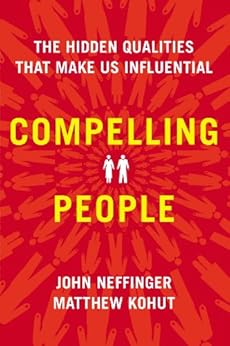
  • Recording of “Compelling People” interview with John Neffinger

    Below is an MP3 recording of the interview I did with John Neffinger, co-author of Compelling People: The Hidden Qualities That Make Us Influential. Now I’ve known John for a while, so I was able to extract some top tips from his book for your delectation and enrichment. Also, John was kind enough to answer questions for 30 extra minutes, which means this interview is 90 minutes of information-packed usefulness. Some of what we covered:

    • The tug-of-war between how warm we appear and how much strength we project, and how to balance the two
    • Tips for nailing a job interview
    • How warmth and strength figured in the fall and rise of Hillary Clinton’s 2008 Presidential campaign
    • The secret of the powerful smile which projects warmth without diminishing strength
    • The special challenges that race and gender present that make projecting strength tricky
    • Exercises to improve the way you present yourself right now

    Download JohnNeffinger_CompellingPeople1013, stick it on your iPhone or iPod or Android gizmo, and listen to it on your daily drive. Or listen to it using the media player here: 

  • Five ways success may be hurting your love life

    If you’re reading this, chances are you’re a hard worker and have accomplished a fair amount in your life. Maybe you have an advanced degree, made vice president at your firm, or started a great company. And maybe in spite of success in your career, success in your love life has still been elusive.

    But what if it’s not despite your success but because of it that your love life is anemic? What if success is inadvertently driving love away from you? Over the years of writing books on love for smart, educated, successful folks like yourself and advising thousands of you, here’s what I’ve observed and some suggested remedies.

    1. You think success is more important than love.

    The biggest impediment to love that I’ve noticed is that people spend so much time on their careers that they don’t have time for people. Between conferences, meetings, all-night coding sessions, month-long trials, overnight hospital shift, and report deadlines, who’s got time for love? Isn’t that a luxury to be attended to once all the important stuff is done?

    Wrong. In his magisterial book, Triumphs of Experience: The Men of the Harvard Grant Study, Dr George Vaillant of Harvard Medical School summarized the findings of the 75-year long ongoing study (more…)

  • Nine ways smart women sabotage their own love lives

    Since I moved to San Francisco, I’ve noticed that there are a lot of great women who are still single. On the one hand, it’s good for business, so I can’t complain too much. On the other hand, it saddens me because many of these women are so fantastic – smart, funny, beautiful – and really don’t want to be single. Not forever, at least.

    It’s probably true the guys you date are partly to blame here. However, every relationship you’ve been in has one thing in common: YOU. So maybe it’s time to take an honest inventory and see if you’ve been engaging in any of the following self-sabotaging behaviors I’ve observed that inadvertently drive off the good guys who already like you (NB: most of these are applicable to men, too, so listen up, gentlemen):

    1. You don’t show up.

    Let’s face it: dates are weird. And it’s perfectly normal to feel some trepidation at the prospect of spending time with a stranger. Especially if that stranger is (more…)

  • “Being Human 2013” in SF 9/28 + “Compelling People” interview Tue Oct 1


    beinghumanlogo

    I’ll make this quick. If you find yourself in San Francisco this weekend (Sat 9/28), I strongly urge you to consider attending Being Human 2013. Some of my intellectual heroes will be speaking there: anthropologist Helen Fisher (Why We LoveAnatomy of Love); neuroscientist David  Eagleman, author of two of my all-time favorite books (Incognito and Sum); and neuroscientist/primatologist Robert Sapolsky (Why Zebras Don’t Get Ulcers and A Primate’s Memoir), who is one of the best lecturers I have ever encountered in my life.

  • Book Review: “Compelling People”, or how to be a more effective human

    best book for increasing your personal power
    A compelling read

    Every once in a while, a book comes along that has the power to really change the way I see the world and move in it. In 2012, it was The Power of Habit: Why We Do What We Do in Life and Business by Charles Duhigg. The year before, it was Thinking, Fast and Slow by Daniel Kahneman. Compelling People: The Hidden Qualities That Make Us Influential by John Neffinger and Matthew Kohut is such a book.

    The central premise of the book is that in any encounter, people base how they feel about you based on how you project strength and warmth. Once you become aware of what your unconscious strength and warmth signals are, you can learn to modulate them to connect better with people, influence them, and just be a more effective all-around human being. From the worlds of psychology, neuroscience, acting, political science, they’ve compiled some of the best practices for presenting your best self to the world.

    Some things I like about this book:

    1) Neffinger and Kohut are seasoned professionals who have coached dozens of nationally-known (more…)

  • How to be taken seriously by a guy you just slept with

    Quick announcement: My excellent friend and colleague, Dr Katherine Woodward Thomas, the author of Calling in the One, which I consider to be one of the best dating books ever written for women, is having a free class on Aug 26 entitled “How To Release Your Hidden Barriers To Love & Become Magnetic To Your Soulmate.” She’s really great. I’ll be telling you more about it in the coming days. In the meantime, you can sign up for it here.

    Now, on to the reader’s letter:

    Hi Dr. Ali — I slept with this guy that I felt strong chemistry with on our second date. How can I “redeem” myself so that he can look at me seriously? What approach to I take to help him see me as g/f or wife material? I am currently reading your book “Tao of Dating” and assume that applying the ideas of masculating your man, giving grace, praise, etc. will help direct his thinking…Thanks, Jacqueline

    Jacqueline —
    Oh my! I didn’t know that you needed to be redeemed for freely following your own desire and sharing a great time with a man. Instead, may I suggest that:

    1) You have done nothing wrong. So you don’t need any redemption. Can I get a “hallelujah”?
    2) Be the buyer instead of being the seller. Right now, the frame that you’re using is (more…)

  • Interview with Shana James: What women need before they can let you in (audio)

    Gentlemen – Have you had any of the following thoughts or experiences?

    •  You feel alone and disconnected during sex
    •  You put so much attention on making a woman feel good that you lose sight of my own pleasure
    •  You felt the spark fade suddenly while having sex and didn’t know how to get it back
    •  You’ve had “performance anxiety”
    •  You wonder if your skills are up to par or if other guys are better
    •  It’s awkward to transition from having a conversation to being sexual
    •  Women act hot and cold with you and only open to your advances sometimes
    •  You’re confused about why some women light up around you but others don’t
    •  You’ve been getting close to a woman when she suddenly chose another man over you

    If so, you’re not alone. I recently did an hourlong interview with my friend & colleague Shana James on “Sex, Orgasm and Intimacy: What Women Need Before They Can (more…)

  • Does unconditional love exist?

    Hi Dr Ali,

    I’m hoping that you can help me to resolve an inner conflict. My understanding of unconditional love is that you accept a person exactly as he is; you do not try to change him. My understanding of boundary setting is that you explain to a person when his behaviour makes you feel uncomfortable or disrespected, and if the behaviour persists, you walk away. If you say to a person “I accept that this is who you are, but I do not accept this behaviour in my life, so I need to leave this relationship”, are you not putting conditions on how you are receiving the person? The person may even believe that he is acting in a loving way, doing his best, yet he is repeatedly demonstrating this behaviour that makes you feel not so great. I know that you are a proponent of “no ego”, but isn’t boundary setting automatically an act of egoism? Walking away from a relationship from a place of “self-love” or “self-respect” still requires “self” or ego. Is there any way to integrate the concepts of unconditional love and boundary setting, which seem to be mutually exclusive? — Tammy from Ottawa, Canada

    Thanks for a great letter, Tammy! Unconditional love, boundaries, ego – all great concepts. And it’s important to remember that they are just that – abstract concepts. Of those, perhaps unconditional love is the most abstract. At best, it’s an unattainable ideal, like the horizon, and at worst a stressful hobby, like chainsaw juggling.

    In fact, the whole point of love between two adults is (more…)